E-flat linchpin

The liner notes for the Philip Jones Brass Ensemble recording of Pictures at an Exhibition contain a brief account of  Elgar Howarth’s arranging process. He wrote something about a particular instrument (maybe a D flugelhorn in the Old Castle) being a linchpin. I’d be more exact, but the LP is in a sealed container in my crawlspace – and I just like the concept.

One of our regular trumpet players couldn’t make the dates work for our first tour of the western United States in 2001. Dan Kuehn (Colorado Symphony) was one of our regular guys and his brother, Dave, happened to be available. What a gift! Among many other things, Dave was the principal trumpet of the Buffalo Philharmonic and he played almost everything on a 4 valve F trumpet.

I was hooked.

Actually, some of the trumpet players in town were early adopters of the then new Yamaha F/G trumpet and they really liked it. But from a practical perspective, the F trumpet is less available than the E-flat – that was the feedback when I started publishing a lot of music.

Nevertheless, the E-flat trumpet is light and clear, but also retains some of the weight in the sound of longer trumpets. Because I view the entire range of a brass ensemble as a continuum from the lowest practical pitches to the highest, and since I like to orchestrate music that explores register and color, I like the way E-flat trumpet makes a seamless transition from one tessitura to another.

I use the E-flat both as a brilliant solo voice and also to transition to a lighter sound in a higher tessitura to piccolo. Typically, I won’t use the E-flat above a written A above the staff (sounding C), or below a written B below the staff (sounding D).

Guidelines…not rules.

For me, E-flat trumpet IS a linchpin.
Why the piccolo trumpet is second fiddle

The way I think about writing for brass has evolved a lot over the years, especially for the instruments with which I’m not intimately familiar. One hopes to keep learning new things and to learn from previous experiences.

I used to write a lot for the piccolo trumpet in my arrangements and still use it quite a bit. But really – a lot. I had the good fortune to write for a couple of guys that loved to play piccolo and it colored my judgement. I’ve since learned that piccolo trumpet is like curry. A little bit goes a long way.

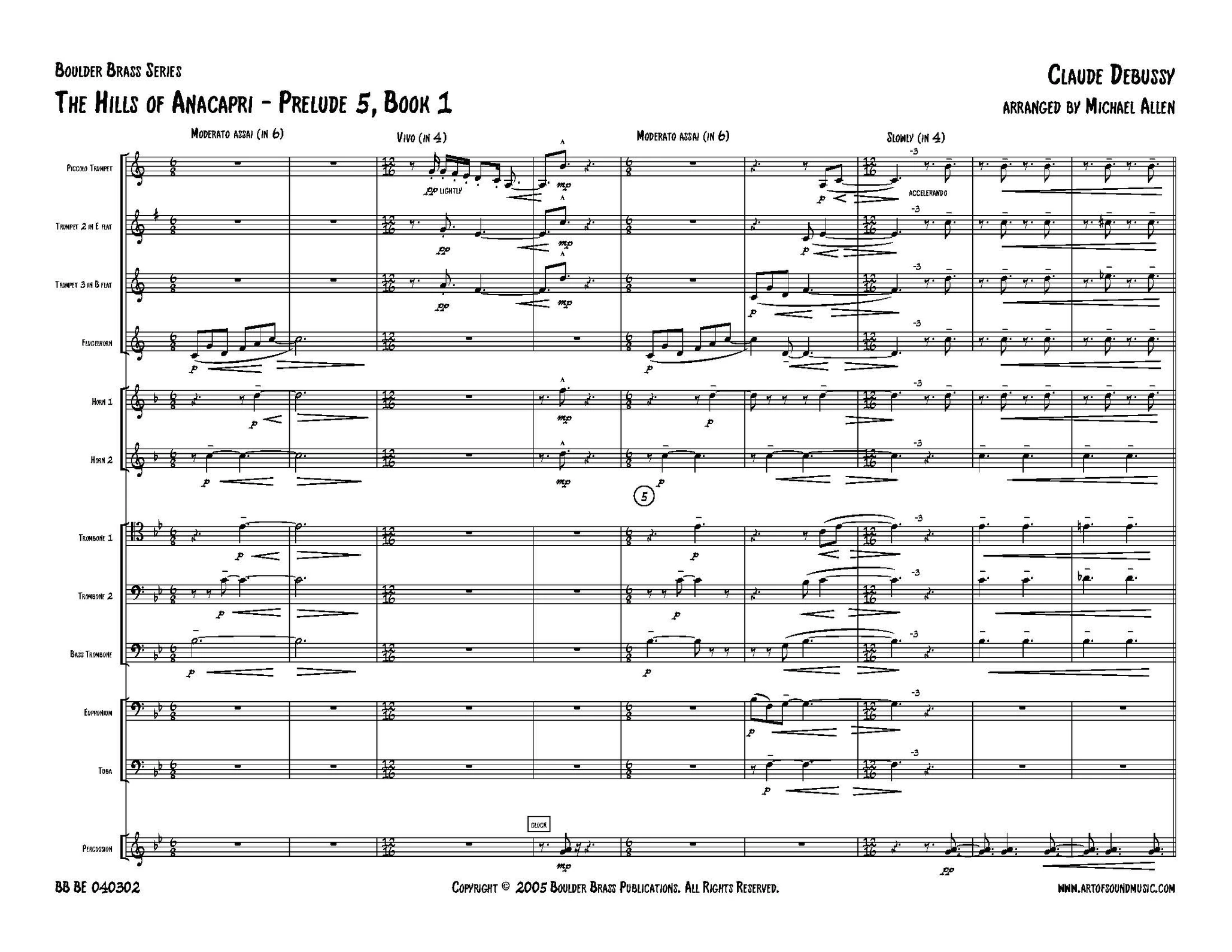
So when I start a chart, the template is E-flat trumpet on top, 2 B flat trumpets, and flugelhorn. If you read my previous post, One on a Part, you might begin to get a sense of why I like the E-flat trumpet (but I’ll write more about that later). Generally, I’ll not notate anything higher than a ‘g’ (first space above the staff) for the E-flat trumpet. If I need to write higher, or if the tessitura of the E-flat part is hovering around the top of the staff all the time, then I’ll consider switching the second player to piccolo and taking some of that hovering high tessitura away from trumpet. I’ll also go back through the E-flat part and see if it doesn’t lay just as well on a bigger horn; but using e flat is usually a color choice.

So putting the piccolo in the 2nd part is about imposing writing discipline – it keeps me from automatically making the 1st trumpet part a screamer.

That’s not about patronizing the trumpets – it IS about the reality of the physical aspect of trumpet playing and hoping that more than one of my charts might appear on a program. Every once in a while, I’ll crack off a piccolo trumpet feature. But, generally, writing for piccolo for me is now more about color, comfort, and security of the tessitura in a part than it is about writing high notes in the chart.

That’s a really important distinction.

Choosing a project

Never being one to shy away from difficult projects, in 1978 I set out to make a version of Toccata and Fugue for my brass playing colleagues in the Wheat Ridge High School band. I worked feverishly on it for weeks and excitedly put it in front of my friends one morning to read.

It was a disaster directly from the upper left hand corner – the only parts that were even close were the tuba and trombone parts. My basic concept for transposition was just wrong and the trumpet and horn parts were a mess.

My brand as an arranger was a wreck.

However, lessons were learned and I leaped into my next big project – the next summer was devoted to orchestrating Pictures at an Exhibition for brass quintet. Still a mess, but a lot closer this time around.

To this day, some 40 years and over 400 arrangements later, I still write an occasional stinker. One big lesson I have learned over that time is to know when to throw in the towel. There are a good number of finished and unfinished charts in the back of my ‘filing cabinet’ that will never see the light of day. There are still more that get a performance in public, and then get deposited in said cabinet.

I have developed an eye and ear over the years for choosing projects that have at least a better-than-average chance of working for my beloved brass ensemble.

Choosing the right music to orchestrate is a big part of the battle.

One on a part

I love the sound of a brass band, and I’ve wanted to find the mojo to write for that ensemble. But I can’t, and it got me to thinking about why.

I was fortunate to have done my undergraduate study at the University of Denver. I was one of only two tuba players in the program which meant a lot of chop time. DU does not have a football program so there was no marching band, and there was no symphonic or concert band. Instead, there was a top-notch orchestra, and an excellent wind ensemble comprising mostly graduate students, under the expert direction of Joe Docksey. Joe was a proponent of the one-on-a-part wind ensemble concept and this ideology became deeply ingrained. It’s also where I became obsessed with Grainger’s music – a subject for another day.

Starting out writing mostly quintet charts, by the time I had written 20 or 30 of them, I had gotten pretty good at making the necessary compromises to make a quintet sing. So the first time I wrote something for brass ensemble, I remember feeling overwhelmed with the thought “what in the hell are you supposed to do with all of these brass players?” Being one to turn challenges into opportunities, it occurred to me that not everyone needed to play all the time (a habit learned from my quintet arranging experience), and that writing for brass ensemble opened possibilities for nearly endless color combinations (duh).

I used to watch a few shows on Food Network – Alton Brown is a favorite. AB likes to say “don’t add anything that doesn’t bring some flavor” or something like that. He was referring to adding water vs. some other liquid to a recipe.

So I rarely write unisons. When I do, it’s even more rare for it to be the same instrument (e.g. 2 tenor trombones or 2 B flat trumpets). To me, that’s an opportunity missed to color a sound in a slightly different way. Horn and trombone in unison have a different color than 2 tenor trombones – even mixing the sound of a bass trombone with tenor trombone changes the color.  That’s not to say that it never happens in my charts, but it’s never just because. It has to serve either a balance or color concern, or solve a voice leading problem.

Other than that, it’s pretty much one on a part.

Why just 2 horns?

I only wrote about five charts using four horns early on for the Denver Brass. In 1988, at my urging Denver Brass went from 4 (or sometimes 3) to 2 horns. Since we were relying heavily on the Philip Jones library for programming, it made no sense to have that many horn players sitting around. It did make sense to occasionally double up the horn part on some of the PJBE charts (see comment below).

During my few years as Denver Brass Music Director and then Artistic Director, I wrote a lot of 423.02 charts. But there was always too much tuba in the mix for my taste – and I am a tuba player. It also meant that when playing PJBE charts, one tuba was playing the bass trombone part, and that simply wasn’t the right sound. I love having the option of 3 or 4 different colors for the bass voice (tuba, bass trombone, euphonium, or a tenor trombone – not to mention a number of other possibilities by combining those voices both in unison and in octaves as the bass voice).

Why did PJBE only have one horn? Philip started his group as a tower music brass group of 2 trumpets and 3 trombones. A little later, on a trip to the US he heard New York Brass Quintet with a tuba (Harvey Phillips) and was hooked. He started a separate group of 211.01, at first with Tug Wilson and a little later, my personal tuba hero, John Fletcher. He later found occasion to combine the forces of the 2 quintets and…414.01.

There is a great book called Odyssey of the PJBE by Donna McDonald (Editions BIM) that chronicles this in more detail.

I felt that the single horn voice sometimes got lost in all the directional instruments. PJBE had some fantastic horn players (Alan Civil, Ifor James, John Pigneguy, Frank Lloyd) that could certainly hold their own, but still…

PJBE was usually chamber music and that was one big goal from the outset with Boulder Brass – a large group that could still play chamber music but could also pin your ears back. 4 horns makes the chamber music part a little more difficult, especially since great horn players are fewer (comparatively speaking) and in high demand for other engagements. Plus you can do a lot with voicing 2 horns by writing notes on reinforcing partials (octaves, for example). Most early classical orchestral music is written four horns only so there is enough note coverage on the natural horns – this is where high horn / low horn got started.

This is also why I like the euphonium in the group. It plays many roles – tenor tuba, 4th horn, solo tenor voice, 2nd or 3rd trombone sound, bass voice of a high conical choir, etc. To be clear, I’m not suggesting euphonium as a replacement for low horn, but it’s there as one possibility to reinforce a smaller horn section.

Most of my charts have a flugelhorn part – another tactic borrowed from brass band music. Flugelhorn can serve as 1st horn, top voice on a trombone choir, rounder bottom voice of a trumpet choir, lovely alto solo voice, and so on.

I’m hooked on this instrumentation, it always makes sense to me as I’m writing, even for music with limited original voices (like a 4 voice Bach fugue) – that’s when it really gets fun to play around with the orchestration color combinations in the group. It’s also one more voice than a pianist has fingers. It’s exactly the right number of voices for organ music (ten fingers and a pedal voice).

I could go on…and probably will.

Regarding instrumentation – Why 423.11?

I started writing brass arrangements while still in high school (late 70’s) after first hearing the Philip Jones Brass Ensemble and Canadian Brass. Several years later, I had the amazing opportunity to write a bunch of stuff for the Denver Brass. The earliest charts were for 443.11. A few of those early arrangements were performed and recorded the next summer by the Summit Brass on their Toccata and Fugue recording.

A year later, the Denver Brass adopted as its standard instrumentation 423.02 (or 422.12) and as music director, I was called upon to write numerous charts for that instrumentation. This was a fabulous laboratory and I learned much about what (and what not) to do.

In 1993, we formed the Boulder Brass with a slightly different instrumentation (423.11 or 424.01) – a couple of our trombone players are also very good euphonium players and this opened up a new world to us. This instrumentation allowed us to explore the PJBE and London Brass library without compromise (and reinforce the horn part when necessary in those charts), and to also create a new library of charts.

There are well over 200 arrangements in our catalog now and those charts are being played all over by some of the worlds great brass players and ensembles.