This will not likely make anyone’s top ten list. I’m going to use this medium as a way to collect my thoughts about a project I’ve started. I’m working on a doctorate in musical arts with an emphasis in tuba performance and pedagogy, with a more precise focus on brass chamber music.
My two big dissertation projects are 1) a comprehensive guide to brass chamber music; and 2) a book on how to score for brass. This seemed like a good place to write some thoughts down, get it organized and, as Seth Godin would say, “ship it.”
Foreword
We lived in Simsbury, Connecticut during my elementary school years and in fourth grade I had the opportunity to choose an instrument. My dad always told me that my grandmother loved the cello, so cello it was.
My dad was 6’7” and my mom right around 6’ so there was a good chance I was going to head in the same direction. By the time I was in seventh grade, I started to really sprout so my music teachers decided the double bass was the right thing for me.
In April of 1975, my dad was transferred from the home office of Connecticut General to a new office opening in Denver, CO. If we had stayed in Connecticut, I probably would not have ended up in music. I was a little league baseball star and that was just as interesting to me as music, though my spare time was divided just about evenly between these two diversions.
We moved to a kind of tough neighborhood in Wheat Ridge and I was thrust into a new Junior High — a tough time for any kid to move anyway. The school was much bigger than I was used to, I was 13, skinny and geeky, and there were bullies. I latched onto the band for inclusion and safety.
Ralph Hinst was my junior high band director in Colorado and he was just the best. He was a terrific cornet player and very encouraging, and because of him I discovered a deep smoldering interest in brass instruments.
He allowed me almost unlimited access to instruments with which to experiment. My first choice was a small bore, bell front hybrid baritone/ euphonium chosen because of its (potentially) rich sound and most of all its portability. I tooled around on it for quite a while, grabbing any sheet music I could lay my hands on and playing along with Bruno Walter and the Columbia Symphony performing Beethoven’s Symphony Number 5 or Leonard Bernstein’s Greatest Hits performed by the New York Philharmonic. Nothing was off limits.
The following school year, my junior high band had a student teacher who, as I recall, was a pretty decent tuba player. Hinst had him play the piccolo part from Stars and Stripes on one of our band concerts and I was hooked.
Then this happened.
I asked the student teacher for help. I wanted desperately to learn how to play the tuba. He declined and it pissed me off. So I asked Hinst if I could take one home for the weekend. He said yes, and so I did — and learned to play it that weekend.
I came back the following Monday, played the cello/bass soli passages from the slow movement of Beethoven 5 for him and won a spot in the symphonic band.
For Christmas later that year, my parents intuitively bought me “Canadian Brass in Paris” and the superb Philip Jones Brass Ensemble recording “Classics for Brass.” The hook was permanently set.
In 1975, the movie Rollerball ignited a new interest in Toccata and Fugue in D minor by JS Bach. Its prominent use in the film created a demand for all things T&F – recordings, sheet music, transcriptions, t- shirts. Of course the interest was not completely new. Disney’s 1939 film Fantasia opens with the most abstract of all the vignettes from that film, with Leopold Stokowski conducting his own over the top orchestration of the mighty organ work.
I saw Fantasia and Rollerball for the first time in 1978, and never being one to shy away from impossible projects set out to make a version of Toccata and Fugue for my brass playing colleagues in the Wheat Ridge High School band. I worked feverishly on it for weeks and excitedly put it in front of my friends one morning to read. It was a disaster directly from the upper left hand corner – the only things I wrote that were even close were the tuba and trombone parts. My concept for transposition was just wrong and my trumpet and horn parts were a mess.
My brand as an arranger was a wreck.
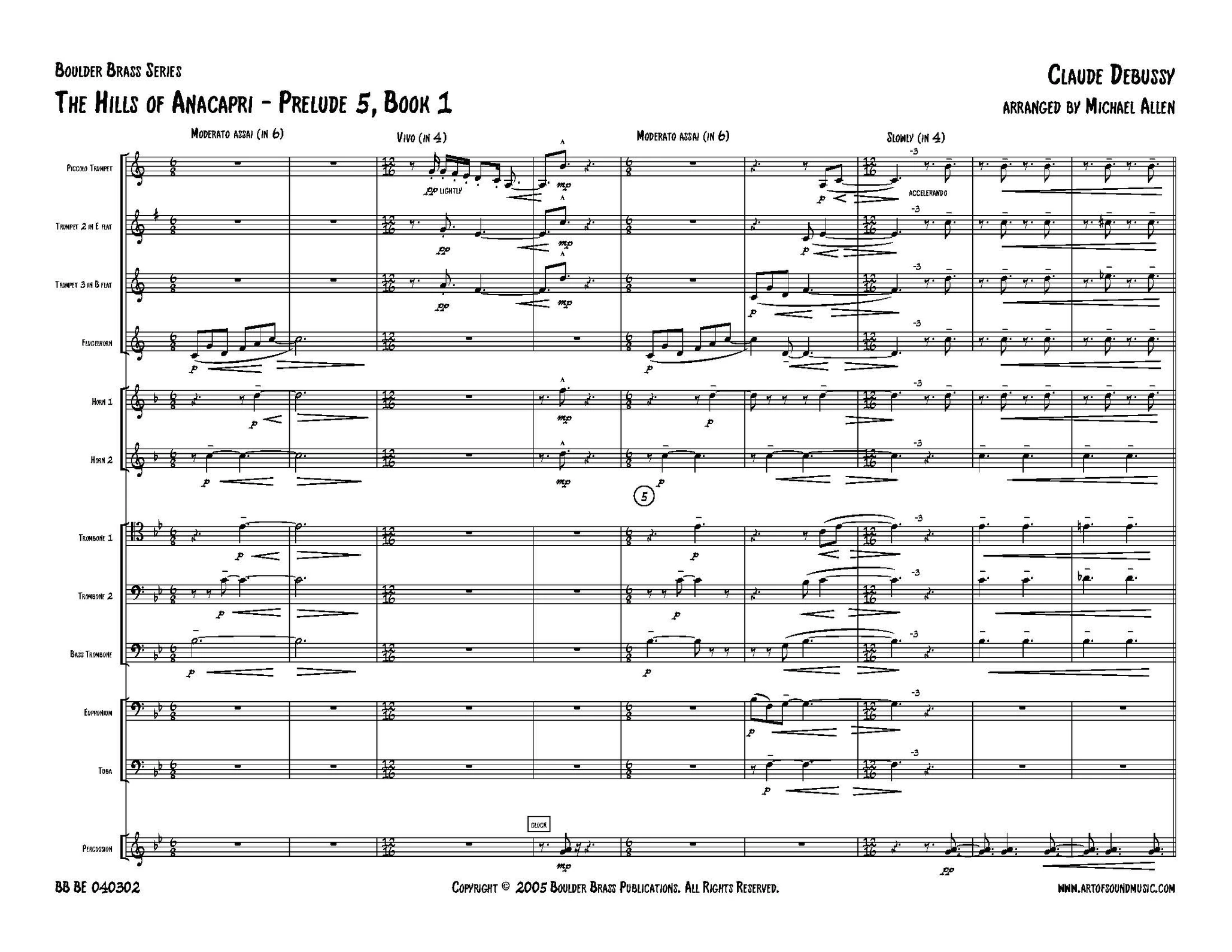
However, lessons were learned and I immediately leaped into my next impossible project – the summer between my junior and senior year in high school was devoted to orchestrating Mussorgsky’s monumental Pictures at an Exhibition for brass quintet. Still a mess, but a lot closer this time around.
To this day, some 35(ish) years and over 400 arrangements later, I still write an occasional stinker. One big lesson I have learned over that time is to know “when to hold ‘em and know when to fold ‘em.” There are a good number of charts in the back of my proverbial filing cabinet that will never see the light of day. There are still more that get a performance in public, and then get deposited in said drawer.
I have also developed an eye and ear over the years for picking pieces that have at least a fighting chance of working for my beloved brass ensemble. I learned so many hard lessons from that first disaster and every botched attempt since then.
It is my hope in the following pages to share some of those lessons. To the experienced brass player, some of this will seem tediously obvious. This isn’t really aimed at the experienced as much as it is intended to be a codification of some of what I have learned in 35 years at the University of Hard Knocks (perhaps my most valuable degree).
So here we go.
 Michael Allen